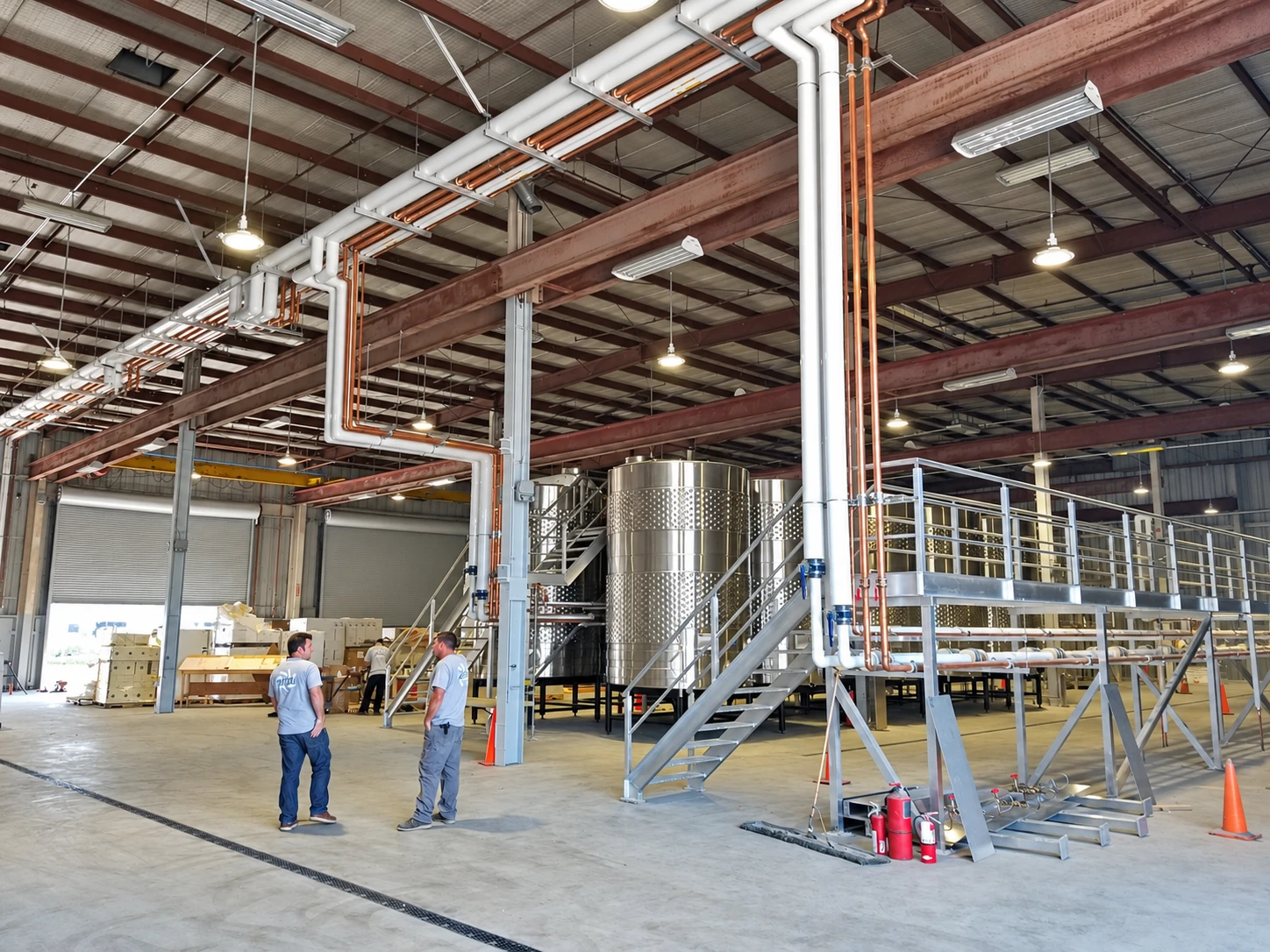
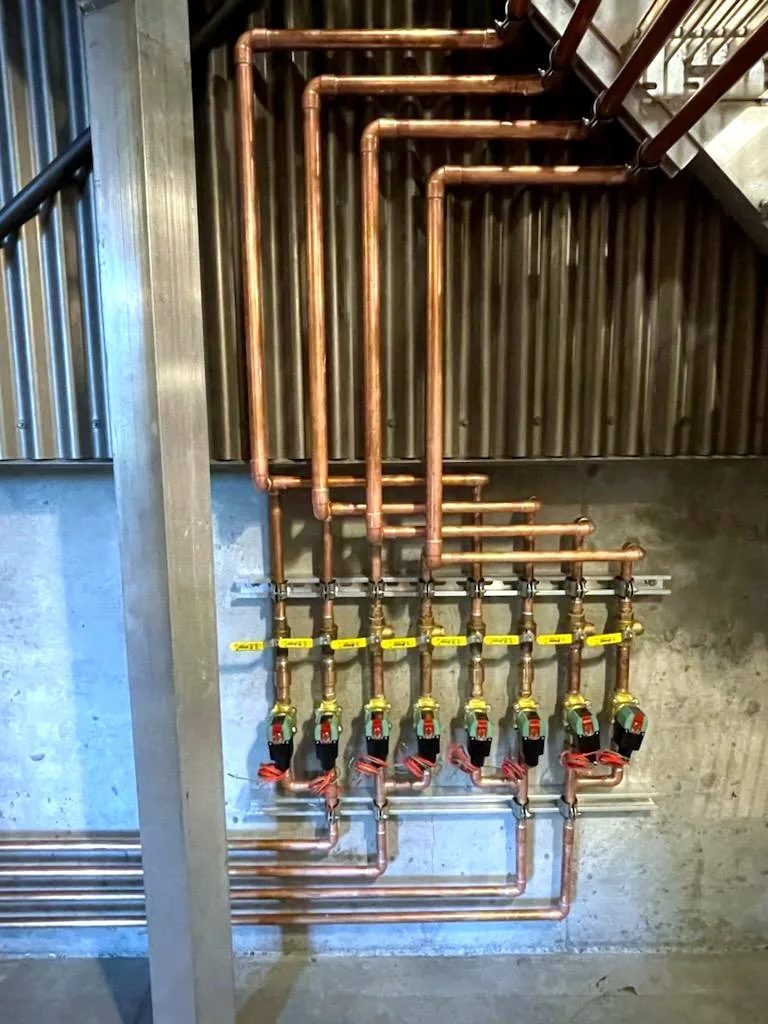
We install and repair process piping for chilled water and glycol systems, including wine Tank Piping and Tank Temperature Controls, for businesses across Sonoma and Napa counties.
We run supply and return Piping between Chillers, Pumps and the equipment they cool, sized with the Chiller and Pumps for new systems, expansions and replacements. We also find and repair leaks, failed Fittings and flow problems in existing lines.
Tank Connections & Piping
We plan supply and return Piping around Tank quantities, jacket requirements and available Chiller and Pump capacity. For an expansion, we review how many Tanks need heating or cooling at the same time.
Individual Tank Controls
You can set and monitor the temperature of each Tank, with options for remote access and equipment integration. We also review existing systems when a Tank is not reaching its setpoint.
Tank Piping Service Calls
Glycol Leak at the End of the Tank Line
Problem: Glycol was leaking near the end of the Tank line.
Repair: We found a cracked PVC Wye Strainer at the warm glycol Heat Exchanger and leaks around the Tank Piping. We drained and collected the glycol, replaced damaged Fittings, Gaskets and Flanges, purged the air and tested the repairs.
Verified outcome: System leak-free and back online. A follow-up check found no leaks at the two affected Tanks.
Broken Glycol Fitting on a Portable Tank
Problem: A damaged glycol line needed repair.
Repair: We replaced a broken Adapter on a portable Tank’s warm glycol supply, restarted the warm Glycol System, purged air from the supply and return lines and checked levels and pressure.
Verified outcome: System back online.
Common Questions
How does a glycol Tank cooling system work?+
The Chiller cools a glycol and water mix, Pumps circulate it through Piping to each Tank’s cooling jacket, and Solenoid Valves controlled by each Tank’s sensor open to cool it to setpoint.
What glycol temperature should go to our Tanks?+
Set it for what your Tanks and process need, not lower. The glycol mix must protect well below your lowest setpoint; if the setpoint gets close to the mix’s freeze point, or glycol flow drops, the Heat Exchanger can freeze and crack. A lower setpoint does not add cooling capacity. Lower operating temperatures can reduce available Chiller capacity. Follow the equipment manufacturer’s requirements for glycol concentration and flow.
Why are our Tanks cooling slowly when the Chiller is cold?+
A cold Chiller doesn’t mean enough glycol is reaching each Tank. Low flow, air in the lines, a stuck or miswired Solenoid, or a clogged Strainer can starve a Tank. We check the flow path, not just the Chiller.
How is Glycol Piping sized for several Tanks?+
We size it from the flow your Tanks need when they cool at the same time, and confirm it during the quote. We leave room for future Tanks.
Why do glycol pipes sweat, and does insulation help?+
Pipes sweat when they are colder than the air’s dew point. Closed-cell insulation with sealed seams, including at Valves and fittings, stops the dripping, ice and corrosion.
What type of glycol should a winery use?+
Use a heat-transfer fluid approved for your equipment and application. Where incidental food contact is possible, use an appropriate food-grade formulation. Set the concentration for the required freeze protection and follow the manufacturer’s instructions.